

Beyond the Boardroom: New Study Shows Why Leaders Who Share Their Vision Dramatically Outperform Those Who Don’t

Great leaders ensure that their vision resonates from the boardroom to the breakroom.
When every employee understands the vision, they know how their work contributes to the bigger picture.
Study shows leaders who share their vision far outperform those who don’t—transparency drives alignment, trust, and stronger results.
MONTREAL, QC, CANADA, April 14, 2026 /EINPresswire.com/ -- A new leadership study from PsychTests reveals a striking pattern: managers who share their vision with employees at every level consistently outperform those who keep strategy confined to high-level executives.
The researchers at PsychTests analyzed 288 current and aspiring managers and divided them into two groups:
• Leaders who believe it’s unnecessary to share their vision with lower-ranking employees
• Leaders who believe every employee—regardless of title—should understand the bigger picture
The performance gap between the two groups wasn’t subtle. It was dramatic.
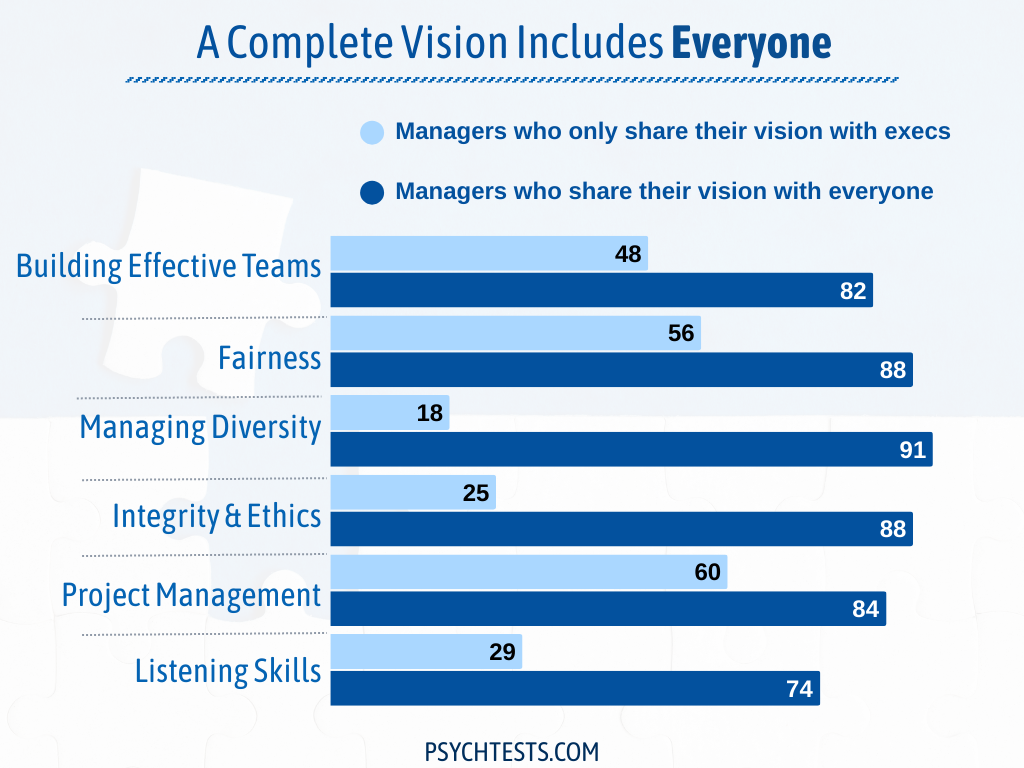
WHAT THE DATA REVEALED (Scores out of 100)
• Problem Solving: 77 (for vision-sharing managers) vs. 39 (for non-sharing managers)
• Monitoring Performance: 86 vs. 44
• Project Management: 84 vs. 60
• Building Effective Teams: 82 vs. 48
• Training & Onboarding: 90 vs. 48
• Fairness: 88 vs. 56
• Managing Diversity: 91 vs. 18
• Integrity & Ethics: 88 vs. 25
Across every key dimension of leadership effectiveness, transparency correlated with stronger performance.
The most striking gap? Managing diversity: 91 versus 18.
When leaders articulate a shared vision, inclusion stops being a policy and becomes a lived experience.
WHY THIS MATTERS?
Leadership isn’t merely directional—it’s relational.
When employees understand where the organization is headed and why, they don’t just execute tasks. They engage with purpose. They connect their role to impact. They contribute more strategically.
“Sharing your vision isn’t about broadcasting strategy,” says Dr. Ilona Jerabek, lead researcher and president of PsychTests. “It’s about alignment. When people understand the larger mission, they stop operating in silos and start operating as contributors. Transparency builds trust—and trust multiplies performance.”
WHY MANY LEADERS DON'T SHARE THEIR VISION?
If the performance gap is this significant, why do so many leaders still operate without transparency?
The answer is more nuanced—and more human—than simple control.
1. They Don’t Have a Clear Vision Themselves
In many organizations, vision is either vaguely defined or communicated only at the highest levels. Middle managers are expected to execute strategy they’ve never meaningfully internalized. Something that is not fully understood and internalized cannot be effectively shared.
2. They Haven’t Translated It for Their Team
Even when leaders understand the company vision intellectually, they often struggle to contextualize it. A vision that feels powerful in a boardroom can feel abstract—or irrelevant—on the front lines. Without personalization, it lands flat.
3. It Feels Inauthentic
If a leader hasn’t aligned the organizational vision with their own leadership values, sharing it can feel performative. Forced enthusiasm erodes credibility. Many choose silence over awkwardness.
4. They’re Operating Transactionally
When the day-to-day pressure is urgent tasks and immediate metrics, vision feels like a luxury. Strategic reflection gets postponed indefinitely.
5. They Underestimate Its Impact
Some leaders assume employees are motivated primarily by compensation and instruction. The data suggest otherwise: meaning and alignment materially influence performance.
In most cases, withholding vision isn’t arrogance. It’s misalignment, lack of clarity, or strategic neglect. And the consequences are measurable.
THE BIGGER LEADERSHIP QUESTION
If transparency correlates this strongly with effectiveness, the real question becomes:
Why are so many leaders still operating behind closed doors?
The data suggests that withholding vision weakens authority.
ABOUT THE RESEARCH
The study was conducted by PsychTests AIM Inc., a global provider of psychometric assessments and leadership diagnostics. The findings are based on behavioral and performance indicators across multiple leadership competencies.
Organizations interested in exploring how vision alignment impacts leadership effectiveness can request additional insights or inquire about leadership diagnostics developed by Dr. Ilona Jerabek. more information about the company's psychometric services can be found on the ARCH Profile website.
About PsychTests AIM Inc.
Founded in 1996, PsychTests AIM Inc. is a global provider of psychometric assessments and leadership diagnostics used by HR professionals, coaches, researchers, and organizations worldwide. The company specializes in evidence-based tools that measure cognitive, behavioral, and leadership competencies with scientific rigor and practical relevance.
Its multidisciplinary team includes psychologists, test developers, statisticians, researchers, and AI specialists dedicated to advancing data-driven insight in talent assessment and leadership development.
Ilona Jerabek
PLUMEUS DBA PSYCHTESTS
+1 514-999-6205
email us here
Visit us on social media:
LinkedIn
Facebook
YouTube
About magnetic leadership
Legal Disclaimer:
EIN Presswire provides this news content "as is" without warranty of any kind. We do not accept any responsibility or liability for the accuracy, content, images, videos, licenses, completeness, legality, or reliability of the information contained in this article. If you have any complaints or copyright issues related to this article, kindly contact the author above.
